Warning
Do not reuse any injection supplies. That includes syringes, needles, alcohol pads and band-aids. You run the risk of infection since these items are no longer sterile. 1
Do not discard any sharps recklessly. Store your syringes and needles in hard plastic containers or a sharps purposed container. 1 Once these containers become full, wrap tape over the silhouette to prevent leakage then discard. Those who’ve been punctured by a needle-stick injury will have to visit the emergency room. 2
Here is more information on how to discard your supplies.
Picking Between Methods
Before injecting, you must know and choose between these two types of injection methods, subcutaneous and intramuscular.
Intramuscular (IM) injection is the introduction of a substance into a muscle, thus the muscular part of the word. 3 Intramuscular injections are typically achieved with longer and wider needles. Length ranging between 1" & 1.6" and gauge (inner diameter) ranging between 19 - 25 G. 4
Subcutaneous (SubQ) injection is the introduction of a substance into the hypodermis. 5 About a centimeter underneath the skin. Whereas IM injections rely on inch long needles to reach the muscle, SubQ can be performed with small 0.5" insulin syringes. 4
The injection process between both are roughly the same. The main differences being in the actual syringes themselves.
Differences between IM & SubQ
Below I’ve wrote 3 sections on the main differences between intramuscular and subcutaneous injections.
- I’ve used both SubQ and IM
Depots
All HRT vials are suspended in thick oils, these oils are called carrier oils. 6
At room temperature, the viscosity can go all the way from 27-33 cP to 1000-1500 cP all depending on the carrier oil used. 7 6 8 This affects not only the pharmaceutical’s pharmacokinetics but also the injection itself. 9
With that said, if you are injecting thick oils right underneath the skin (SubQ). It’s expected you’ll see visible, itchy, potentially painful, swollen bumps that may last for days. These are called oil depots, depots for short. 10 Whereas noticeable depots are an uncommon occurrence with intramuscular injections since the oil is injected deeper.
How intramuscular and subcutaneous handle depots is the most prominent difference between both injection methods. IM may hurt more on the initial injection, but you are also avoiding long term irritation from the swollen depot. 11
Deadspace
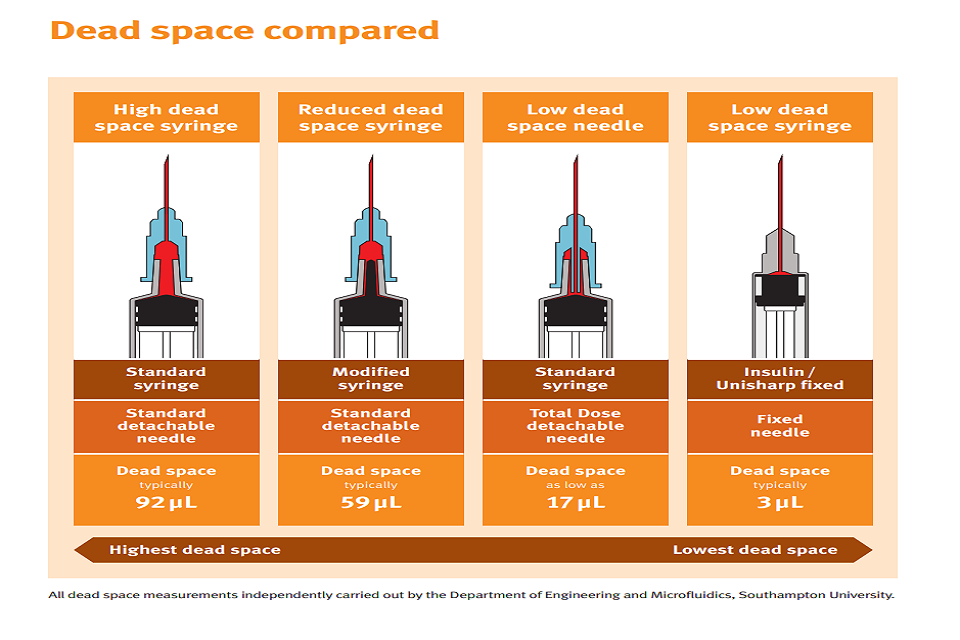
Deadspace refers to the leftover fluid volume from a syringe post injection. 12
Deadspace varies depending on the type of syringe you use. Deadspace is an important factor to consider since a significant amount of liquid can be lost per injection. As seen by the far-left panel, 0.92mL was lost from that injection. This will shorten a vial’s lifespan since 0.92mL will be lost every injection.
Typically intramuscular syringes have higher deadspace than subcutaneous syringes. SubQ is commonly done with regular insulin syringes (0.03mL deadspace) and IM done with standard syringes. However you can reduce the deadspace IM uses by instead injecting with low deadspace syringes/needles. 12
Pharmacokinetics
Pharmacokinetics describes the behavior of a drug inside the body over time. Factors like methods of administration affect the pharmacokinetics (ie. Intramuscular, Subcutaneous).
Subcutaneous administration of testosterone esters resulted in a steadier curve over intramuscular. Alongside delayed time of maximum concentration (Tmax) and lower concentration variation (CV). 13 However, both IM and SubQ have shown similar pharmacokinetic profiles and serum levels. With no statistically significant differences between neither regarding testosterone levels/AUC. 14 15 11
As for adverse events, One study found Subq and IM showed statistically significant differences in hematocrit (HCT). 14 High HCT being a contraindication for testosterone. 16 Another study compared historical rates of polycythemia from intramuscular studies to their own results and found SubQ’s risks were reduced. 17 However with weak evidence altogether, this is merely suggestive.
Oil leakage from injection sites are more likely to occur in SubQ administration over IM due to depth differences. IM also has the upper hand of Z-Tracking. This may affect serum levels if this shows as a persistent issue. Converting to intramuscular may serve as a solution or simply waiting with the needle penetrated for 3 seconds. 18
- The 1st and 3rd paragraphs should apply to estradiol esters as well.
Comparison Table
| Trait | Subcutaneous (SubQ) | Intramuscular (IM) |
|---|---|---|
| Injection Depth | Hypodermis Injection | Muscle Injection |
| Needle Length | Short (0.5"-0.6") | Long (1"-1.6") |
| Oil Leakage | More Likely | Less Likely |
| Absorption | Steadier & Delayed | Variable & Swift |
| Deadspace | Low (0.02mL) | Usually High (0.1mL) |
| Pain | More Painful Long term | More Painful Short term |
How to Inject
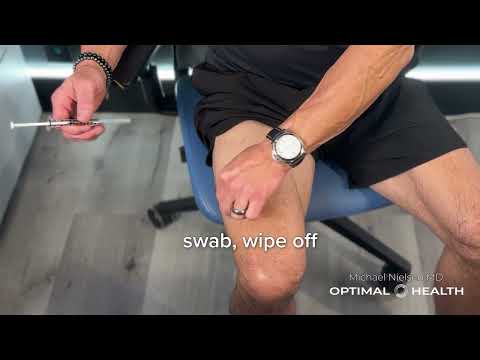
Above is a thigh intramuscular injection video you can watch off YouTube.
You can use this as a visual guide alongside the list of steps I wrote below. Watching this as a guide for SubQ injection is also possible. The primary steps you’ll be replacing with instead are Part F & G.
These steps were majorly written using the materials published by the Nursing Times. 19 20
IM A. Gather Supplies
- Grab 1 Needle / 2 Instead for Tough Skin
- Grab 1 Syringe
- Grab 1 Bandaid
- Grab 3 Alcohol Pads
- Grab Sharps Container
- Grab Vial
- If you went through male puberty, you probably have tough skin.
SubQ A. Gather Supplies
- Grab 1 Insulin Syringe
- Grab 1 Bandaid
- Grab 3 Alcohol Pads
- Grab Sharps Container
- Grab Vial
B. Plan Injection Site
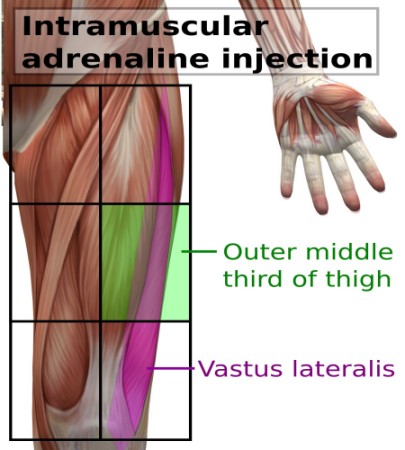
- Look at this Graphic
- Pick Between Right or Left Thigh
- Focus on the Green Square, Inject There, Remember
- The graphic works for SubQ as well.
C. Sanitize
- Grab 2 Alcohol Pads
- Sanitize the Vial’s Rubber Top
- Sanitize the Injection Site
- You should have 1 Alcohol Pad Left.
D. Draw Setup
- Attach Needle & Syringe, Uncap Needle
- Draw Up Air Equivalent to the Milliliters You’re Injecting
- Penetrate Needle Through the Middle of the Vial
- Inject Air in Vial for Pressure Maintenance
- Keep Syringe in for Part E
E. Draw Liquid
- Hold Syringe inside Vial, as you Flip Both Upside Down
- Pull & Hold the Syringe Plunger Back, Let Gravity Aid
- Be Patient & Continue Holding Until you Reach your Desired Dosage
- Flip Vial & Syringe Back to Normal Orientation
- Remove Syringe, Recap Temporarily as Needed for Part-F
IM F. Injection Setup
- Read Explanation here on Z-Tracking
- Hold the Syringe in your Dominant Hand
- Follow Part-F2 for Tough Skin, Resume Here Once Done
- Spread the Injection Site’s Skin Thinly Across
- Displace Skin by 1" Inch for Z-Tracking
- Z-Tracking is optional.
SubQ F. Injection Setup
- Hold the Syringe in your Dominant Hand
- Pinch a Bundle of Fat from the Injection Site
F2. Injection Setup (2 Needles / Tough Skin)
- Pull Plunger Back so all Deadspace Liquid Enters the Chamber
- Remove Current Needle and Cap it for Safety
- Install New Needle
- By avoiding dual-usage for drawing & injecting, the needle will be sharper.
IM G. Inject
- Remove Needle Cap
- Aim Needle Straight, 90 Degrees
- Inject Needle using Entire Needle’s Length
- Push the Plunger Slowly until Empty
- Count till 10 Secs Before Withdrawing
- Withdraw Syringe Quickly
SubQ G. Inject
- Remove Needle Cap
- Aim Needle Straight to the Pinched Fat, 90 Degrees
- Inject Needle using Entire Needle’s Length
- Push the Plunger Slowly until Empty
- Count till 10 Secs Before Withdrawing
- Withdraw Syringe Quickly
H. Wrap Up
- Wipe the Injection Spot with Leftover Alcohol Pad
- Apply Bandaid
Congrats you’re now done. Recap the needle, dispose of all the leftovers and place both the Syringe and Needle in the Sharps Container.
Z-Tracking
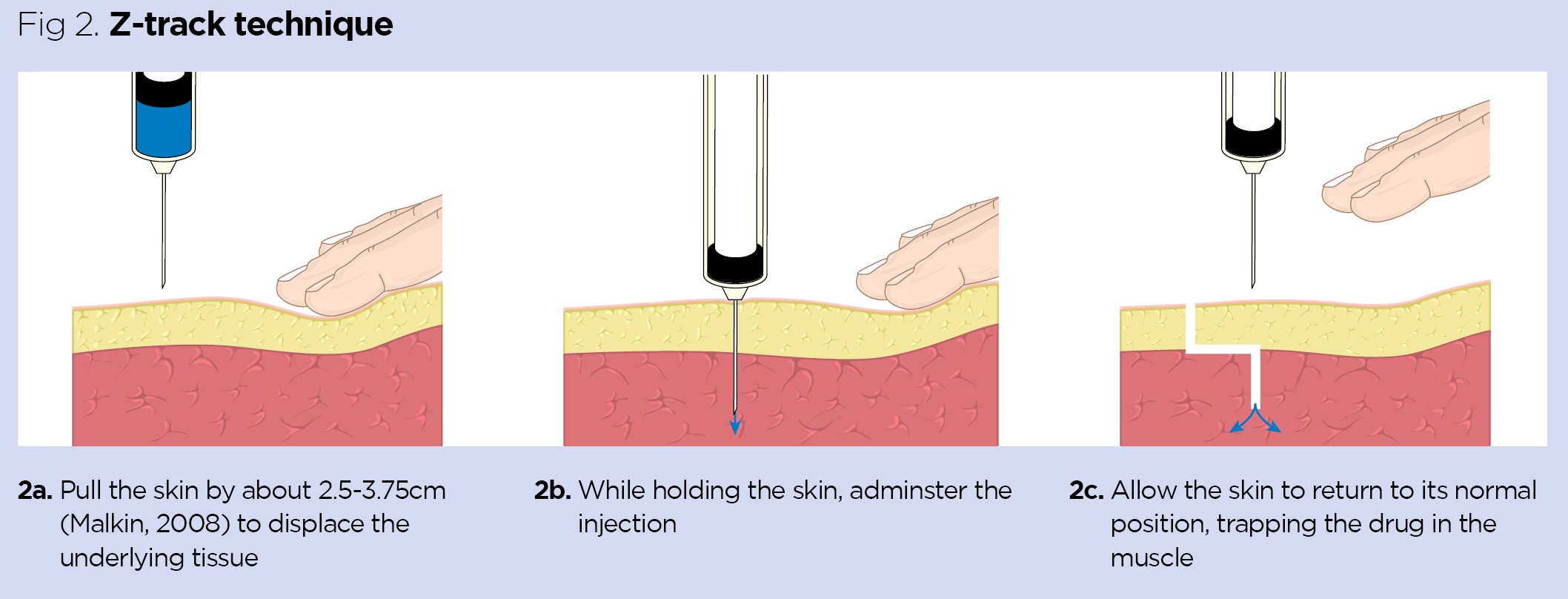
The Z-Track injection method is a intramuscular injection practice aimed at preventing leakage and pain. Skin is displaced creating a zig-zag like pattern when needle is withdrawn. This traps oil inside the muscle, preventing leakage.
A study has concluded Z-Tracking did indeed reduce oil leakage significantly. However the exact same could not be said for pain management. Where pain albeit reduced was not significant. 21
Primary Supplies
Researching sources, finishing tonight or 12th Aug.
Syringes
Needles
Bundles
Miscellaneous Supplies
Alcohol Pads
Band-Aids
Sharps Container
Discarding Supplies
Kaiser Permanente. Learning about safe needle use and disposal. Kaiser Permanente. https://healthy.kaiserpermanente.org/health-wellness/health-encyclopedia/he.learning-about-safe-needle-use-and-disposal.acj0769 ↩︎ ↩︎
Department of Health & Human Services. Needlestick injury. Better Health Channel. https://www.betterhealth.vic.gov.au/health/conditionsandtreatments/needlestick-injury ↩︎
Merriam-Webster. Intramuscular. In: Merriam-Webster.com Dictionary. Accessed August 9, 2026. https://www.merriam-webster.com/dictionary/intramuscular#medicalDictionary ↩︎
Becton, Dickinson and Company [BD]. Principles of injection technique. BD. Accessed August 9, 2026. https://www.bd.com/content/dam/bd-assets/na/medication-delivery-solutions/documents/in-service-material/BD-2125_Principles_of_Injection_Technique.pdf ↩︎ ↩︎
Subcutaneous (SQ) injections: MedlinePlus Medical Encyclopedia. https://medlineplus.gov/ency/patientinstructions/000430.htm ↩︎
Larsen SW, Thing MA, Larsen C. Oily (Lipophilic) Solutions and Suspensions. In: Long Acting Injections and Implants. ; 2011:113-135. doi:10.1007/978-1-4614-0554-2_7 ↩︎ ↩︎
Noureddini H, Teoh BC, Clements LD. Viscosities of vegetable oils and fatty acids. Journal of the American Oil Chemists Society. 1992;69(12):1189-1191. doi:10.1007/bf02637678 ↩︎
Chart OV. Viscosities of common fluids - Oil viscosity Chart. https://oilviscositychart.com/learn/viscosity-list.php ↩︎
Behre H, Abshagen K, Oettel M, Hubler D, Nieschlag E. Intramuscular injection of testosterone undecanoate for the treatment of male hypogonadism: Phase I studies. European Journal of Endocrinology. 1999;140(5):414-419. doi:10.1530/eje.0.1400414 ↩︎
Figueiredo MG, Gagliano-Jucá T, Basaria S. Testosterone therapy with subcutaneous injections: a safe, practical, and reasonable option. The Journal of Clinical Endocrinology & Metabolism. 2021;107(3):614-626. doi:10.1210/clinem/dgab772 ↩︎
Turner L, Ly LP, Desai R, et al. Pharmacokinetics and acceptability of subcutaneous injection of testosterone undecanoate. Journal of the Endocrine Society. 2019;3(8):1531-1540. doi:10.1210/js.2019-00134 ↩︎ ↩︎
Kesten JM, Ayres R, Neale J, et al. Acceptability of low dead space syringes and implications for their introduction: A qualitative study in the West of England. International Journal of Drug Policy. 2016;39:99-108. doi:10.1016/j.drugpo.2016.09.005 ↩︎ ↩︎
Figueiredo MG, Gagliano-Jucá T, Basaria S. Testosterone therapy with subcutaneous injections: a safe, practical, and reasonable option. The Journal of Clinical Endocrinology & Metabolism. 2021;107(3):614-626. doi:10.1210/clinem/dgab772 ↩︎
Choi EJ, Xu P, Barham D, El-Khatib FM, Yafi FA, Kavoussi PK. Comparison of Outcomes for Hypogonadal Men Treated with Intramuscular Testosterone Cypionate versus Subcutaneous Testosterone Enanthate. The Journal of Urology. 2021;207(3):677-683. doi:10.1097/ju.0000000000002301 / Not intensive AND quantified with minimum 5 half-lives. ↩︎ ↩︎
Wilson DM, Kiang TKL, Ensom MHH. Pharmacokinetics, safety, and patient acceptability of subcutaneous versus intramuscular testosterone injection for gender-affirming therapy: A pilot study. American Journal of Health-System Pharmacy. 2018;75(6):351-358. doi:10.2146/ajhp170160 / Not intensive AND quantified with minimum 5 half-lives. ↩︎
Bhasin S, Cunningham GR, Hayes FJ, et al. Testosterone Therapy in Men with Androgen Deficiency Syndromes: An Endocrine Society Clinical Practice Guideline. The Journal of Clinical Endocrinology & Metabolism. 2010;95(6):2536-2559. doi:10.1210/jc.2009-2354 ↩︎
Williamson T, Trussler J, McCullough A. 14 Erythrocytosis in subcutaneous testosterone replacement therapy. The Journal of Sexual Medicine. 2022;19(Supplement_1):S7-S8. doi:10.1016/j.jsxm.2022.01.025 ↩︎
Præstmark KA, Stallknecht B, Jensen ML, Sparre T, Madsen NB, Kildegaard J. Injection technique and pen needle design affect leakage from skin after subcutaneous injections. Journal of Diabetes Science and Technology. 2016;10(4):914-922. doi:10.1177/1932296815626723 ↩︎
Shepherd E. Injection technique 1: administering drugs via the intramuscular route Nursing Times. 2018;114(8):23-25. ↩︎
Injection technique 2: administering drugs via the subcutaneous route Nursing Times. 2018;114(9):55-57. ↩︎
Dedeoğlu Y, Khorshid L, Yilmaz D. The Effect of the Z-Track Technique on Pain and Drug Leakage in Intramuscular Injections Clinical Nurse Specialist. 2016;30(6):E7-E12. doi:10.1097/NUR.0000000000000245 ↩︎